


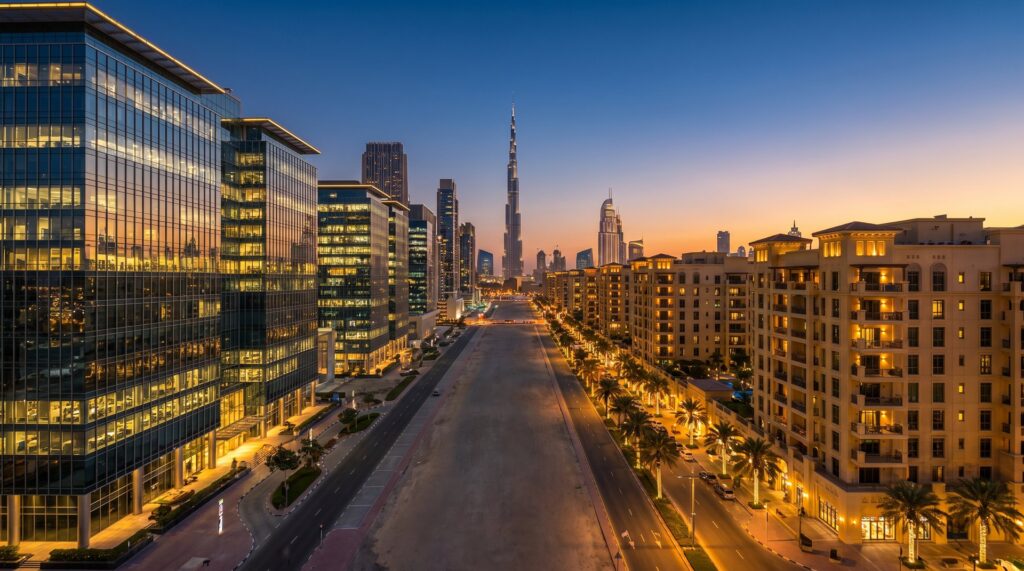
Most people arrive at Dubai property through the residential door. It’s familiar, the marketing is everywhere, and the entry price is manageable. Commercial real estate sits off to the side — bigger tickets, fewer brokers pushing it, less written about it.
That asymmetry is worth examining, because Dubai’s commercial market has been the quieter outperformer of this cycle.
The current picture
Residential is normalising after a record run. Through the first half of 2026 Dubai recorded around 79,000 residential sales worth roughly AED 221 billion — volumes below the 2025 peak, but pricing holding up, with the major indices putting annual growth in the 5–7% range and average values near AED 1,900 per square foot. Citywide gross rental yields sit around 6.6%.
Commercial has been running hotter on rents. CBRE’s Q2 2026 review put Dubai office rents up 13% year-on-year, with occupancy in the mid-90s and prime space effectively full. Grade B rents have risen fastest as occupiers priced out of Grade A trade down. Office sale prices have climbed alongside, with meaningful capital appreciation on top of the rental growth.
The driver is straightforward: companies keep relocating and expanding here — finance, technology, professional services, logistics — while quality office delivery has lagged. Around 24 million square feet of office space is scheduled between 2026 and 2030, but most of it lands from 2027 onward, so the near-term squeeze persists.
How the two behave as investments
Lease structure
This is the difference that matters most, and it’s the one new investors most often overlook.
Residential tenancies in Dubai are typically one year, sometimes paid in one to four cheques. Every twelve months you’re back in the market — renewal negotiation, possible vacancy, possible re-letting commission. Rent increases are governed by the RERA rental index and Decree No. 43 of 2013, which caps how much you can raise rent depending on how far below market the current rent sits. You cannot simply reprice to market on renewal.
Commercial leases run longer — three, five, sometimes ten years — with escalation clauses written into the contract. A single well-underwritten corporate tenant can produce a decade of predictable income with none of the annual churn. Fit-out costs also make commercial tenants sticky: a business that has spent AED 500,000 building out an office is not moving over a modest rent increase.
Yield and volatility
Commercial typically prices at a higher yield than comparable residential, compensating for lower liquidity and higher tenant concentration risk. But that’s the trap in the comparison — a residential building with twelve apartments losing one tenant is at 92% occupancy. An office floor with one tenant losing that tenant is at zero, and it may sit empty for months while you find a replacement.
Residential income is diversified and shallow. Commercial income is concentrated and deep. Neither is safer in the abstract; they fail differently.
Tenant management
Residential means dealing with individuals, and individuals have washing machines that break at 11pm, cheques that bounce, and personal circumstances that change. Commercial usually means dealing with a company’s facilities manager, and often a lease where the tenant carries responsibility for their own fit-out and internal maintenance.
Fewer, more professional counterparties is genuinely less work. It’s also less forgiving when one goes wrong.
The tax and cost difference
Here’s a real distinction specific to the UAE, and it catches people out.
Residential sales and leases are exempt from VAT. Commercial property is subject to 5% VAT on both sale and lease, and if your taxable supplies pass AED 375,000 over twelve months you must register with the FTA and account for it properly. That’s an administrative burden and a cash-flow consideration on every rent invoice.
Financing differs too. Banks are more conservative on commercial assets — expect lower loan-to-value, shorter tenors and higher pricing than the residential equivalent. The 4% DLD transfer fee applies to both.
Where each one wins
Choose residential if:
- Your capital is under roughly AED 3 million and you want a diversified, liquid entry point
- You want the deepest possible buyer pool at exit — end-users plus investors, local plus international
- You value being able to sell one unit rather than an entire asset
- You’re not equipped to underwrite a corporate tenant’s credit
- You want a Golden Visa qualifying asset (the AED 2 million property threshold is the most common route in — confirm current criteria before relying on it)
Choose commercial if:
- You want long leases and predictable, escalating income rather than annual renegotiation
- You have the capital to buy a decent asset in a district with real occupier demand, and a reserve to carry a vacancy
- You can assess a tenant covenant, or you’re buying somewhere the demand is deep enough that a replacement tenant is a question of weeks not quarters
- You’re prepared to handle VAT registration and compliance
- Your horizon is genuinely long — commercial is slower to trade in and out of
The honest risk on each side
Residential’s risk is supply. Dubai is delivering a very large number of apartments, concentrated in specific districts. If you buy in a submarket about to absorb thousands of similar units, your rent growth flattens no matter how strong the citywide numbers look. Location-specific pipeline analysis is not optional.
Commercial’s risk is the timing of that 2027-onward delivery. Today’s rent growth reflects a shortage that will partially resolve. If you underwrite a purchase assuming double-digit rental growth continues indefinitely, you’ll be disappointed. Underwrite it on today’s rent, or a slightly conservative version of today’s rent, and let any further growth be upside.
The answer for most investors
Start residential. Learn how Dubai actually works — Ejari, service charges, the rental index, what a real net yield looks like after everything comes out. That knowledge costs less to acquire on a AED 1.5 million apartment than on a AED 8 million office floor.
Move to commercial when you have capital you can leave illiquid for years, a reserve that can cover a vacancy without pressure, and the ability to underwrite a tenant rather than a district.
Investors who go straight to commercial because the yield headline looks better tend to discover the difference between a headline and a net return at the worst possible moment. The ones who build up to it usually do well.