


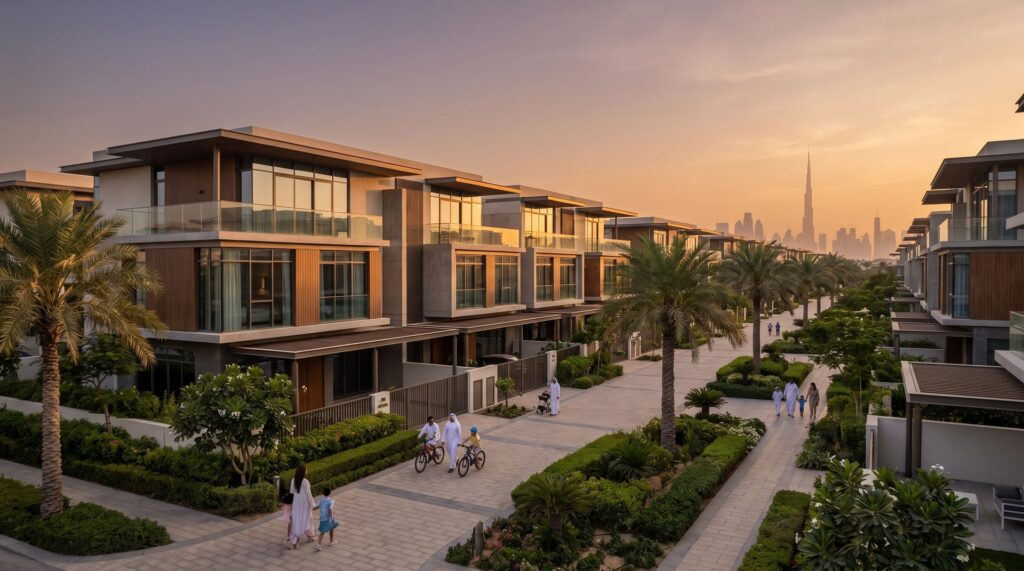
Ask ten Dubai investors what to buy and you’ll get two loud answers. One camp swears by apartments — higher yields, lower entry price, easier to rent. The other points at villas, where prices have run hardest since 2021. The townhouse sits quietly between them, and that middle position is exactly why it deserves a closer look.
Here’s what the numbers actually say, and who this asset class suits.
What a townhouse gives you that an apartment doesn’t
A townhouse is a multi-storey home sharing one or two walls with its neighbours, usually inside a gated master community with its own pool, park, gym and retail strip. Think Arabian Ranches, Damac Hills, Town Square, Tilal Al Ghaf, Villanova, Al Furjan.
For a tenant, the pitch is simple: villa living without the villa price. Three or four bedrooms, a private garden, covered parking, a community school within a short drive. For families relocating to Dubai on a school-year cycle, that package is close to non-negotiable — and there aren’t many of them.
That scarcity is the whole investment case. Villas and townhouses make up under a fifth of Dubai’s residential stock, and roughly the same share of the incoming pipeline. Apartments are being built at a pace that will test rents in certain districts over the next three years. Low-density family housing is not.
The yield trade-off, stated honestly
Townhouses do not out-earn apartments on rental yield. As of mid-2026, Dubai’s citywide average gross residential yield sits around 6.6%, and the split by asset type is instructive:
- Apartments: roughly 6.9% gross, with high-supply districts like JVC pushing higher
- Townhouses: roughly 5.1% gross
- Villas: roughly 4.5% gross
If cash flow is your only objective, a well-chosen apartment wins. Full stop.
Where townhouses have compensated is capital growth. Villa and townhouse pricing has consistently outrun apartments through this cycle, and forecasters expect that gap to persist — ValuStrat’s 2026 outlook projected around 17.7% growth for villas and townhouses against 7.4% for apartments. Even the conservative houses put low-density growth comfortably ahead of the apartment segment.
So the honest framing is this: a townhouse is a total return play. You accept a point and a half of yield to buy exposure to the supply-constrained end of the market.
Where townhouses genuinely beat both alternatives
Tenant stability. Families sign, stay, and renew. A three-bedroom townhouse near a good school typically turns over far less often than a one-bedroom in a tower full of transient professionals. Every avoided vacancy month is roughly 8% of your annual rent, and every avoided re-let costs you a commission you didn’t have to pay. Those savings never appear in a gross yield figure, but they show up in your bank account.
Service charges. Townhouse service charges are generally lower per square foot than tower charges, because you’re not funding lifts, chillers, a concierge desk and a podium pool. Two properties advertised at the same gross yield can be a percentage point apart on a net basis once service charges, and that difference compounds over a hold period.
Exit liquidity. Your buyer pool includes end-users, not just investors. When investor sentiment cools — and it periodically does — family homes hold bids better than investor-stock apartments, because the person buying is choosing a life, not a spreadsheet.
What it actually costs to get in
Budget for the purchase price plus 6–8% in transaction costs. On a AED 2.8 million townhouse:
- DLD transfer fee — 4%, or AED 112,000. Legally split between the parties, but market convention in Dubai puts the whole amount on the buyer
- Trustee office fee — AED 4,200 for properties above AED 500,000
- Agency commission — typically 2%, so AED 56,000
- Mortgage registration — 0.25% of the loan amount, plus admin
- Valuation, title deed and NOC fees — a few thousand dirhams combined
One rule catches new buyers out constantly: since the Central Bank tightened its guidance, banks can no longer roll these closing costs into the mortgage. They must come from your own cash, on top of the deposit. Expat residents can currently borrow up to 80% on a completed property under AED 5 million, so on that AED 2.8m townhouse you’re looking at roughly AED 560,000 deposit plus around AED 190,000 in fees. Verify the current cap with your broker before you commit — the Central Bank adjusts these.
Off-plan or ready?
Off-plan townhouses are the standard route into new master communities, and the payment plans are genuinely attractive — 10% on booking, construction-linked instalments, sometimes a post-handover tail. But note the financing rule: bank lending on off-plan is capped at 50% loan-to-value, disbursed against construction milestones. The developer’s payment plan is doing the heavy lifting, not the bank.
Ready townhouses cost more per square foot and demand more cash on day one. In exchange you get a rent cheque immediately, a real community you can walk through rather than a render, and no handover-delay risk.
If you need income now, buy ready. If you’re buying growth on a five-year view and can service the instalments from other income, off-plan in a proven developer’s master plan has historically been the better entry.
Who should skip this asset class
Be direct with yourself. A townhouse is probably the wrong purchase if:
- You need maximum monthly cash flow from a limited amount of capital
- Your budget can’t absorb the deposit and the closing costs and a maintenance reserve
- You’re planning to exit inside 24 months — an 8% round-trip in transaction costs eats a lot of a short-term gain
- You’re buying in a location whose schools, retail and road links are still on a masterplan rather than on the ground
That last one matters more than any other. Two townhouses of identical spec in different communities can perform completely differently, and the variable is almost always infrastructure maturity.
The verdict
For an investor with a five-year-plus horizon who wants a defensible asset in the thinnest part of Dubai’s supply picture, the townhouse is a strong buy in 2026 — provided you go in knowing you’re trading yield for growth and stability, not getting both.
For a pure income investor with limited capital, a well-located apartment still does the job better.
Run the numbers on the specific unit, not on the asset class. Pull the actual service charge from the RERA service charge index, check what comparable units in that community are genuinely renting for on Ejari-registered contracts rather than asking prices, and stress-test the deal at a 5% yield rather than the 7% someone quotes you.
The Dubai market rewards buyers who do that. It’s been considerably less kind to the ones who don’t.